
Digital Sustainability Consultancy
It’s estimated that the average website produces around 0.8g of carbon dioxide per page view. If your site gets 1,000 views a day, that’s 800g of carbon dioxide produced, adding up to 292 kilograms a year. We help organisations of any size understand the impact of their site and how to apply the small changes that drive big reductions.
The invisible issue we’re all part of
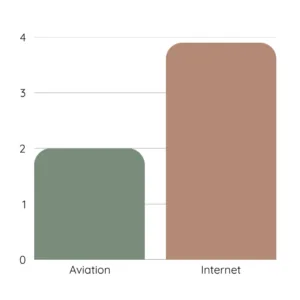
Internet usage currently accounts for up to 3.9% of global greenhouse emissions each year (ahead of aviation’s 2%).
People criticised Taylor Swift for using her private jet, but none of us criticised each other for having a website. The good news is we can all do our part to lessen this issue.
How it happens
To provide an outstanding experience, modern websites are teeming with data rich content; high resolution images, video and interactive design, all managed by complex code, and using significant energy to load every user interaction. Each element of a page may seem small, but they add up and multiply each time your page is loaded.

Websites rely on the transfer of data between the front-end (webpage) and the back end (server).

The server compiles the necessary data, delivering it via switches, servers, routers and caches – each step requiring energy.

The more data that is transferred, and the greater the distance it is moved, the more energy is required to load a web page.
Why you should care
Saving the planet may not be at the top of your priorities as a business, especially if you’re not sure where to start. There are four main reasons to get involved.

Improved site speed
Most digital sustainability improvements will make your site faster and site speed is an important ranking factor, helping to contribute to more visibility in search results and a better user experience.

Better conversion rates
A 0.1 second improvement in site speed typically results in a 8.4% increase in transactions, or a 5.5% increase in lead generation.

Better customer alignment
52% of consumers want to buy from brands whose values they share, and 73% of global consumers are willing to change consumption habits to reduce environmental impact.

Higher business value
A 2022 Schroders analysis found that businesses excelling in environmental sustainability are valued at 25x their earnings, compared to 17x for less sustainable counterparts.
How we reduce your impact
As with so many things, knowledge is the key to improvement. No matter how small/large your site is, we run a full assessment of your impact.
Step 1: Audit
We gather a complete overview of how your entire website performs and the carbon dioxide produced by your site over a year, as well as an indication of how much better it could be. We can also give you an indication of carbon offset options if you want to offset previous emissions from your site.
Step 2: Analyse
We examine where the biggest improvements could be made and which pages need the most attention. These tasks are shared with you along with an indication of the effort needed to fix them and the impact they would have.
Step 3: Improve
At this stage, we put everything we’ve learned/recommended into motion. We can either help you to make improvements, recommend a partner who could help you, work alongside your development team, or you can take the recommendations and find your own solutions.
Step 4: Measure
When all the fixes have been applied to your site, we run our audit process again, and tell you how much you’ve reduced your emissions. At this stage, we can also make updated recommendations on how best to offset your website carbon footprint, helping to reduce the impact of your site in the future.
Calculate the impact of your page
Need a quick indication of how well your pages perform before committing to a full audit? Click the button below…
Case studies
Take a look at some of the work we’ve been doing, and the impact it’s had.
-

62% Reduction in Average Carbon Emissions Within 24 Hours
About the Brand Kreative Freedom is a modern creative agency offering flexible freelance graphic design services to businesses of all sizes. The agency specialises in…

Knowledge base
Some thoughts, guides, and practical advice to help you get started.
How digital sustainability increases business value
Why doing the right thing digitally can also strengthen your business.
The hidden cost of email signature images
A small detail that’s quietly adding more impact than you might expect.
Image optimisation: The overnight speed win
One of the quickest ways to make your website faster, lighter, and more efficient.
FAQs
Some of the common questions that come up, along with straightforward answers.
Any organisation with a digital presence can benefit. For smaller businesses, it’s often about improving performance and reducing costs. For larger organisations, it’s about managing scale, reducing risk, and embedding sustainability into digital strategy and governance.
Common contributors include large media files, inefficient code, excessive third-party scripts, unnecessary tracking tools, and poorly optimised content. These issues often go unnoticed but can significantly increase emissions at scale.
Digital carbon is estimated based on factors such as page weight, data transfer, energy usage, and infrastructure, using V4 of the Sustainable Web Design Model. While exact figures may vary slightly, measurement provides a useful benchmark to identify inefficiencies and track improvements over time.
No. Smaller organisations often benefit just as much, if not more, because small inefficiencies can have a disproportionate impact on performance, cost, and user experience. Starting early also prevents problems from scaling later.
Reducing unnecessary data, improving performance, and streamlining systems can lower hosting costs, improve conversion rates, and reduce ongoing development overhead. For many organisations, sustainability improvements align directly with cost savings and operational efficiency.
No. Most organisations can achieve meaningful improvements without a full rebuild. Digital sustainability typically starts with identifying inefficiencies and making targeted changes that reduce waste and improve performance over time.
Digital sustainability complements broader ESG initiatives by addressing emissions within digital operations. It can support reporting, demonstrate progress, and highlight areas that are often overlooked in traditional sustainability programmes.

Start making the world a better place
Whether you’re looking for quick wins or a longer-term strategy, we’ll help you understand where you are today and what practical steps will make the biggest difference. If you’re ready to move beyond good intentions and start making measurable change, we’re here to help.